How to Choose Window Treatments Without Losing Your View
One of the best parts of living near the coast is the view. Whether your home overlooks the ocean, Intracoastal Waterway, marsh, canal, golf course pond, or another scenic area, the last thing you want is a window treatment that hides the reason you love your windows in the first place.
At the same time, large windows can create challenges. Bright sunlight, glare, heat and privacy can make leaving them completely uncovered impractical.
The good news is that you don't necessarily have to choose between covering your windows and enjoying your view.
The right window treatment can give you control over light and privacy while keeping your view as open as possible.
At Carolina Custom Shutters, we help homeowners throughout Brunswick County choose window treatments based not only on how they look, but also on how they want to use their windows every day.

Start With the View
Before choosing a window treatment, think about what you want to see when you're sitting in the room.
This is especially important in coastal homes where windows may overlook the ocean, marsh or waterway.
Ask yourself:
Which part of the window provides the best view?
Do you need privacy during the day, at night, or both?
Does direct sunlight make the room uncomfortable at certain times?
Is glare a problem when watching television or working on a computer?
Do you want the window treatment almost completely out of sight when it's open?
The answers can quickly narrow down your options.
A beautiful window treatment isn't necessarily the best window treatment if it constantly blocks the view you bought the house to enjoy.
Plantation Shutters Can Provide Excellent View Control
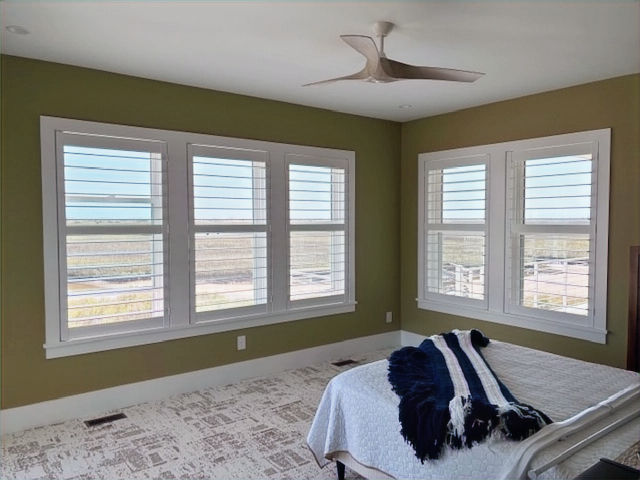
Plantation shutters are a popular choice for coastal homes because the louvers can be adjusted without completely covering the window.
Opening the louvers allows you to see through the shutter while still having the ability to change their angle when you need more privacy or less direct sunlight.
Louver size can make a noticeable difference.
Larger louvers generally mean fewer horizontal lines across the window and a more open view through the shutter. For homeowners who want plantation shutters but place a high priority on maintaining their view, 3½-inch and 4½-inch louvers are often worth considering.
Shutters can also be configured with independent sections of louvers. For example, you may be able to close the lower portion for privacy while leaving the upper portion open for light and a view.
That flexibility is one of the reasons plantation shutters work so well in rooms where the view changes in importance throughout the day.

Roller Shades Can Nearly Disappear When Raised
If your priority is having as little material as possible in front of the glass when the window treatment is open, roller shades are another excellent option.
When fully raised, most of the shade material rolls neatly into the top of the window.
That leaves the majority of the glass unobstructed.
Roller shades are also available in different fabric opacities. This is important because you don't always have to choose between a completely open window and a completely blocked view.
Certain light-filtering and solar fabrics can reduce brightness and glare while allowing some visibility through the shade.
The appropriate fabric depends on the direction the windows face, the amount of sunlight they receive, the level of privacy you need and how important the view is while the shade is lowered.

Consider Top-Down/Bottom-Up Cellular Shades
Sometimes the part of the window you need to cover isn't the part containing the view.
That's where a top-down/bottom-up cellular shade can be particularly useful.
Instead of operating only from the bottom of the window upward, these shades can also be lowered from the top.
Imagine a window overlooking the water where neighboring homes or pedestrian traffic create a privacy issue along the lower portion of the window. You can cover the area where privacy is needed while leaving another portion of the glass open.
Cellular shades can also provide insulation and light control, making them worth considering for windows that receive significant sun exposure

Think About Where the Window Treatment Goes When It's Open
Homeowners naturally spend a lot of time considering how a window treatment looks when it's closed.
For a home with a great view, the opposite question may be even more important:
What does the window treatment look like when it's completely open?
Every product has somewhere to go
Plantation shutter panels remain in the window opening unless the panels themselves are swung open.
Roller shade fabric rolls toward the top of the window.
Cellular shades compress into a stack.
Roman shades form folds as they're raised.
Before choosing a product, consider how much of your glass will remain covered when the treatment is in the position you'll use most often.
A few inches can make a surprisingly large difference on a window with a spectacular view.
Don't Forget About Window Frames and Dividers
The window itself also affects the view.
Existing sashes, meeting rails and vertical window dividers already create lines across the glass. A properly designed window treatment can sometimes work with those architectural elements instead of adding unnecessary visual clutter.
With plantation shutters, for example, divider rails can often be positioned to correspond with existing window meeting rails.
Panel configuration also matters.
The goal should be to design the shutter around the proportions and construction of the existing window rather than treating every window exactly the same.
This is one of the advantages of having window treatments measured and designed specifically for your home.
Consider How Sunlight Changes Throughout the Day
A water view that looks perfect at 9:00 in the morning can become extremely bright later in the afternoon.
The direction your windows face makes a difference.
East-facing windows can receive intense morning sunlight, while west-facing windows often experience strong afternoon sun and glare. Large south-facing windows may receive substantial sunlight for much of the day.
Water can make the situation even more noticeable because reflected sunlight can produce significant glare.
Before choosing a window treatment, consider the room at different times of day.
You may discover that you don't need to block the view—you simply need better control over the light entering the room.
Privacy and a View Aren't Always Opposites
Privacy is another major consideration, particularly in coastal communities where homes can be relatively close together.
But privacy doesn't always require covering the entire window.
Adjustable plantation shutter louvers can redirect sightlines.
Top-down/bottom-up shades can cover one section of glass while leaving another open.
Some shade fabrics can provide daytime light and glare control while maintaining a degree of visibility to the outside.
It's important to remember, however, that fabrics that provide daytime privacy may not provide the same privacy after dark when lights are on inside the home.
That's why the best solution depends on how the room is actually used.

Choose the Window Treatment Around the Room
There isn't one window treatment that's best for every room—or even every window in the same house.
A living room overlooking the Intracoastal Waterway may prioritize an unobstructed view.
A west-facing bedroom may need significantly more light control.
A bathroom may make privacy the first priority.
A dining area overlooking the marsh may need only occasional protection from glare.
Instead of choosing one product simply because you like its appearance, consider the specific job the window treatment needs to perform in each room.
Window Treatments for Coastal Homes in Brunswick County, NC
Homes in Brunswick County offer some incredible views—from the beaches of Ocean Isle Beach, Sunset Beach and Holden Beach to the waterways, marshes and coastal communities around Calabash, Oak Island and Southport.
Those views should be part of the conversation when you're choosing window treatments.
At Carolina Custom Shutters, we help homeowners compare plantation shutters, roller shades, cellular shades, Roman shades and other window treatment options based on the actual windows in their homes.
We consider the view, sunlight, privacy requirements, window construction and how you want the room to function before recommending a solution.
Because the best window treatment isn't simply the one that looks good in the window.
It's the one that lets you enjoy your home—and your view—the way you want to.
Ready to Explore Your Options?
If you're considering new window treatments for a home in Brunswick County, Carolina Custom Shutters can help you determine which products provide the right balance of view, privacy, light control and style.
Schedule an in-home consultation and we'll help you compare options using the actual windows, lighting and views in your home.
Call us: 910-712-6695
Email us: carolinacustomshutters@gmail.com


Comments